Turbidity (Tu)
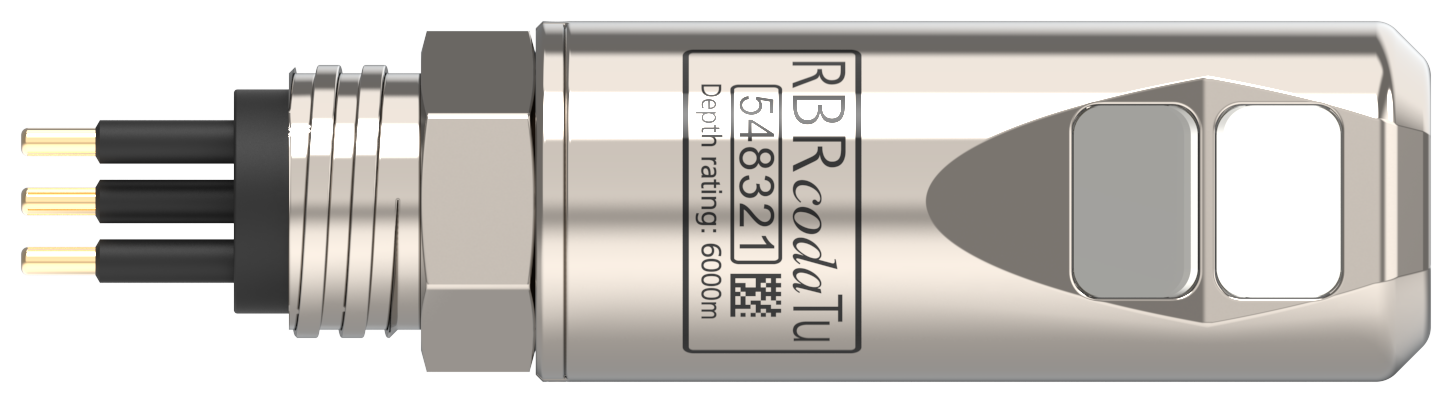
RBR standard instruments with a "Tu" in the name, such as RBRvirtuoso3 Tu or RBRconcerto³ C.T.D.ODO.Tu, may use the RBRcoda Tu (Fig. 28), as well as turbidity sensors from third-party manufacturer Sequoia (Fig. 29).
The RBRconcerto3 and RBRmaestro3 can integrate the RBRtridente three-channel sensor, capable of making multiple fluorescence and backscatter or turbidity measurements simultaneously.
Turbidity sensors detect light scattered by solid particles suspended in water. During deployments, minimise direct sunlight.
RBRcoda Tu
The turbidity channel of the RBRcoda Tu ensures high sensitivity in the low range (0-1000FTU), while the optical backscatter channel is designed for high-turbidity applications (up to 20000FTU). RBR calibrates the optical backscatter channel to ensure the highest accuracy around and above 1000FTU, thus achieving alignment between these two channels through their intended measurement conditions.
Turbidity
| Parameter | Value |
|---|---|
Channel wavelength |
880nm |
Centroid angle |
90° |
Linearity, R2 |
0.99 |
Initial accuracy |
5% |
Calibrated range1 |
0-1000FTU |
Measurement range1 |
0-1500FTU |
Detection limit |
0.005FTU |
1 Response becomes non-linear above 1000FTU.
Turbidity (optical backscatter)
| Parameter | Value |
|---|---|
Channel wavelength |
880nm |
Centroid angle |
135° |
Linearity, R2 |
0.99 |
Initial accuracy |
5% |
Calibrated range1 |
1000-4000FTU |
Measurement range1 |
0-20000FTU |
Detection limit |
2.0FTU |
1 Response is linear between 500 and 15000FTU.
Sequoia
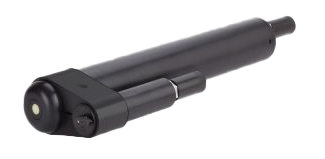
| Parameter | Value |
|---|---|
Light source wavelength |
850nm |
Acoustic backscatter |
8MHz |
Range1 |
0-3000FTU |
Depth rating |
100m |
1 Not factory-calibrated.
Calibration equations
Turbidity
Backscatter