Fluorescence (Fl)
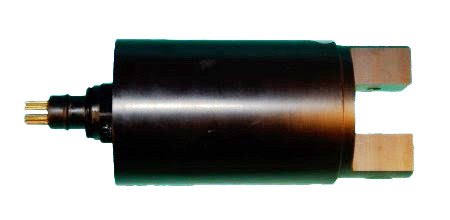
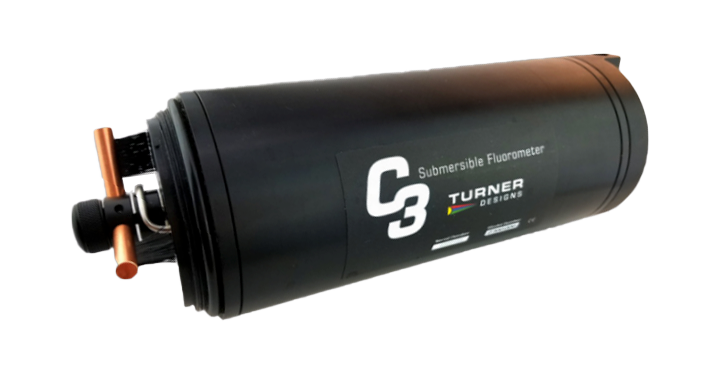
RBR standard instruments support a variety of fluorescence sensors, such as the RBRcoda chl-a (Fig. 17), as well as sensors from third-party manufacturers Seapoint (Fig. 18) and Turner (Fig. 19). Additionally, the RBRconcerto3 and RBRmaestro3 can integrate the RBRtridente three-channel sensor, capable of making multiple fluorescence and backscatter or turbidity measurements simultaneously.
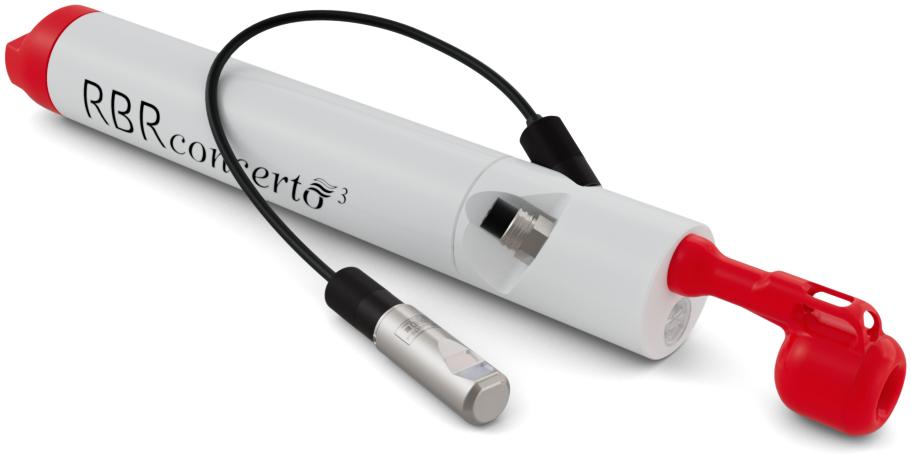
Overview
Fluorometers operate by transmitting a beam of light and then detecting the light emitted by the excited particles of organic matter suspended or dissolved in seawater. They can measure chlorophyll concentration, crude oil, dissolved organic matter (DOM), and a variety of synthetic dyes.
|
Chromophoric dissolved organic matter (cDOM) is the subset of DOM which absorbs light. Only a fraction of cDOM fluoresces, hence the term fluorescent dissolved organic matter (fDOM). Fluorometers always measure fDOM, even when they report cDOM or cDOM/fDOM. |
RBRcoda chl-a
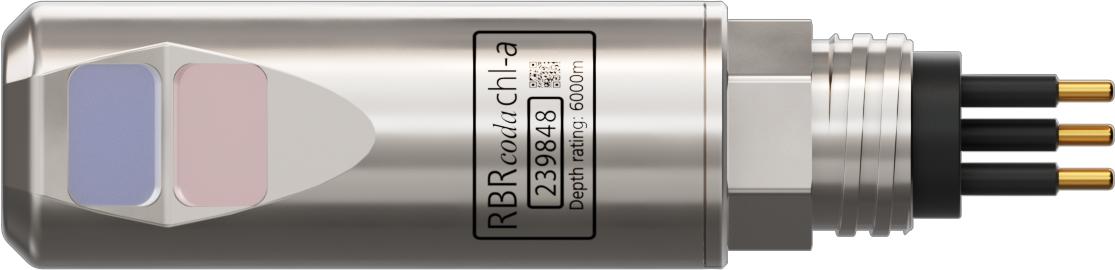
Optical
| Parameter | Value |
|---|---|
Linearity, R2 |
0.99 |
Initial accuracy |
5% |
Chlorophyll-a
| Parameter | Value |
|---|---|
Wavelength |
470nm/695nm (excitation/emission) |
Calibrated range1 |
0-50µg/L |
Measurement range |
0-500µg/L |
Detection limit1 |
0.020µg/L |
1 Scaled for the in vivo fluorescence response.
Seapoint
| Parameter | Value |
|---|---|
Output time constant |
0.1s |
Wavelength, excitation/emission |
470nm / 685nm (chlorophyll a) |
Sensing volume |
340mm3 |
Depth rating |
6000m |
Turner
| Parameter | Value |
|---|---|
Wavelength, excitation/emission |
440nm / 680nm (chlorophyll a) |
Minimum detection limit |
|
Depth rating |
600m |
Calibration equations
Fluorescein
Chlorophyll a