Conductivity (C)
RBR standard instruments with a "C" in the name, such as RBRduo3 C.T, or RBRconcerto3 C.T.D.ODO.Tu, use integrated inductive conductivity sensors which measure the ability of seawater to conduct electric current.
Overview
RBR manufactures four variants of inductive conductivity cells (Fig. 8):
-
750m-rated black C cell
-
750m-, 2000m-, and 6000m-rated CFD-optimised red CT cells, with temperature and conductivity sensors integrated as a single unit.
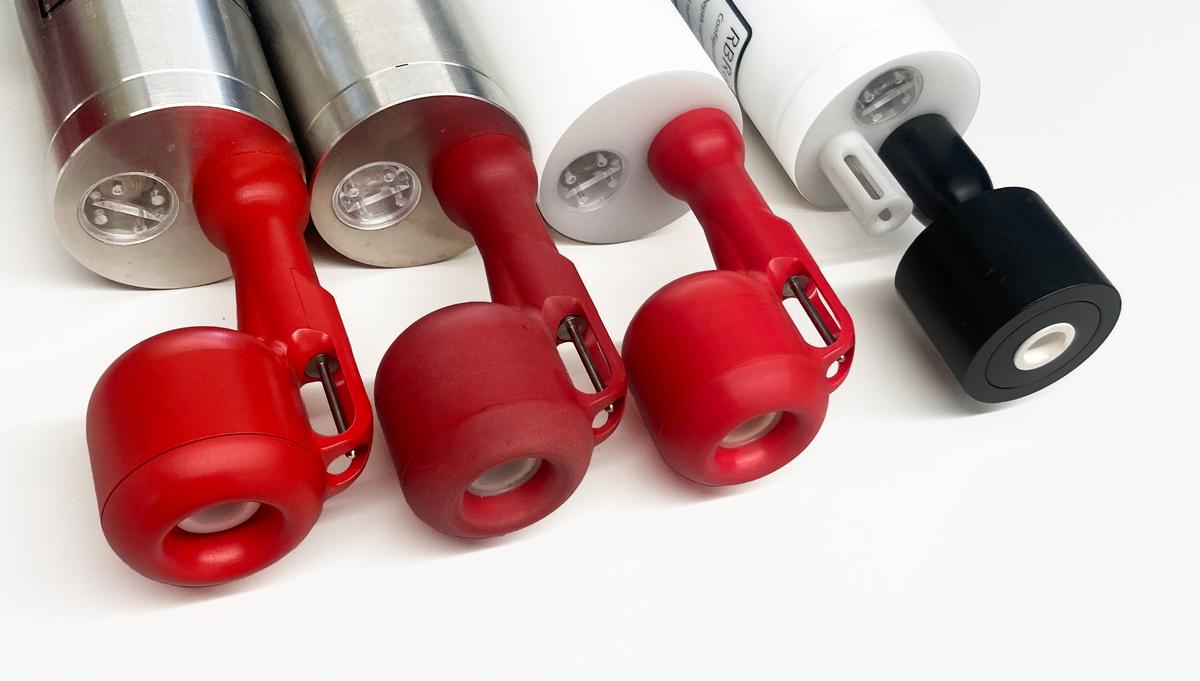
The three red CT cells are rugged and durable. They are not affected by surface contaminants or freezing conditions, and can be frozen into ice. RBR used computational fluid dynamics (CFD) to optimise their design. The black C cell has a simpler design which makes it easier to clean and maintain. This variant is perfect for moored applications.
The conductivity sensor is streamlined for hydrodynamic flushing through and around it, and does not require a pump, thus ensuring totally silent operation. While 80% of its volumetric measurements happen inside the cell, the measurement volume also extend up to 15cm away and thus may be affected by conductive and non-conductive objects within this distance. RBR calibrates conductivity sensors to account for static objects, such as cages, guards, and other sensors.
|
To maintain optimal accuracy, deploy your instrument with the same cage or guard as used during calibration and at least 15cm away from other objects. |
Conductivity measurements are temperature compensated.
Specifications
| Parameter | Value |
|---|---|
Range |
0 to 85mS/cm |
Initial accuracy |
±0.003mS/cm |
Resolution |
<0.0001mS/cm |
Typical stability |
±0.010mS/cm/year |
Max depth rating |
750m, 2000m, or 6000m (depending on the variant) |
Raw conductivity
where
-
C0-C1 are unit-specific calibration coefficients determined in the laboratory
-
VR is the measured Voltage Ratio
Temperature and pressure compensated conductivity
where:
-
Craw is the uncorrected conductivity
-
Tcond is the internal temperature of the conductivity cell
-
Tcal is the average temperature during the room-temperature pressure calibration run
(stored as "X5" in the instrument). -
Pmeas is the measured, temperature compensated, absolute pressure (see Temperature compensated pressure)
-
Pcal is the nominal pressure while performing the temperature calibration segment
(stored as "X6" in the instrument) -
X0 - X4 are unit-specific calibration coefficients
Derived parameters: salinity, density anomaly, specific conductivity, speed of sound, oxygen concentration, oxygen saturation